Published on Sat Oct 24 2026 16:55:00 GMT+0000 (Coordinated Universal Time) by cresencio
Under the Lights: Our Primetime Record and Week 7’s Next Tests
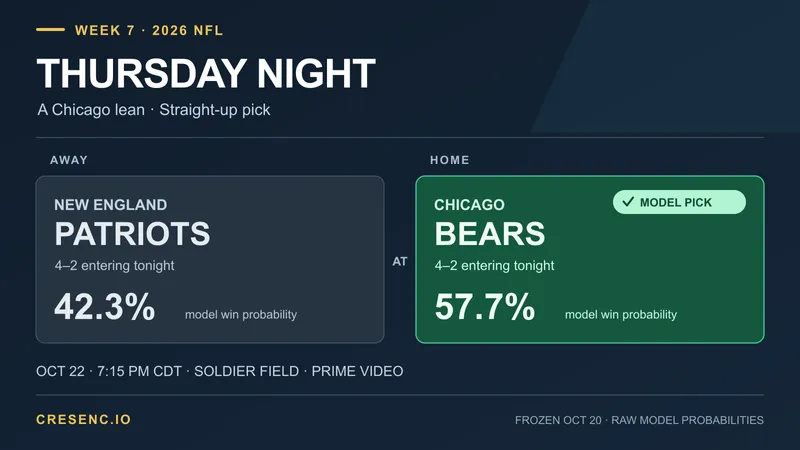
Three correct winners, three correct spread picks, and two correct totals. That is our ensemble’s record across the latest three completed primetime games, capped by Chicago’s 30–24 win over New England on Thursday. The current streaks extend to four correct winners and six correct spread picks.
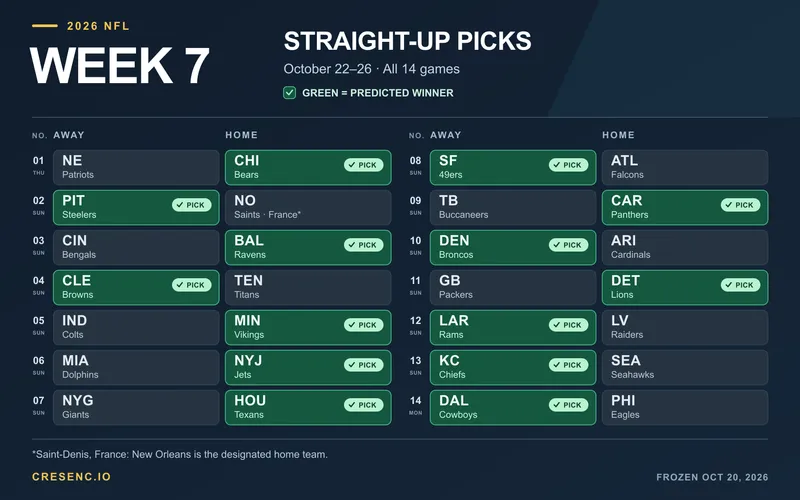
Before Kansas City visits Seattle on Sunday night and Dallas visits Philadelphia on Monday, here is how that run fits the season record—and what Saturday’s prices tell us about the next two games. The forecasts remain those published in the full Week 7 preview.
The latest three games
Here is the saved ensemble record for the latest three completed primetime games. Spread and total selections come from the probability forecasts at their original lines; they are not reconstructed from the final scores.
| Game | Final score | Winner pick | Spread pick | Total pick |
|---|---|---|---|---|
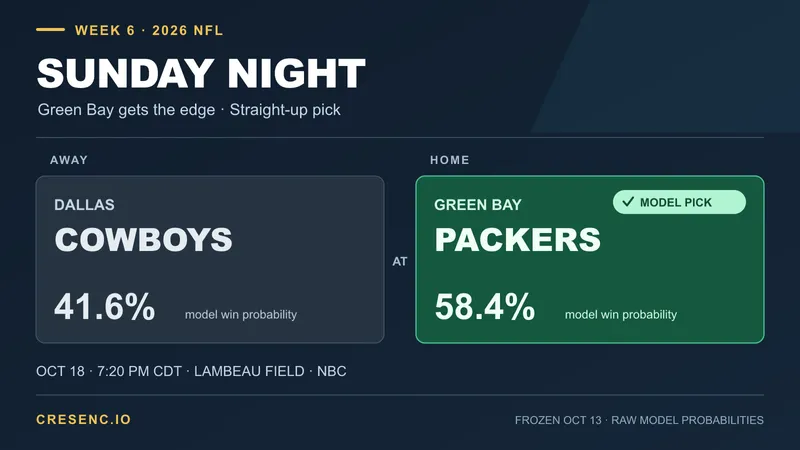
| Dallas at Green Bay, October 18 | Green Bay 23–13 | Green Bay — correct | Green Bay −1 — correct | Under 53 — correct |
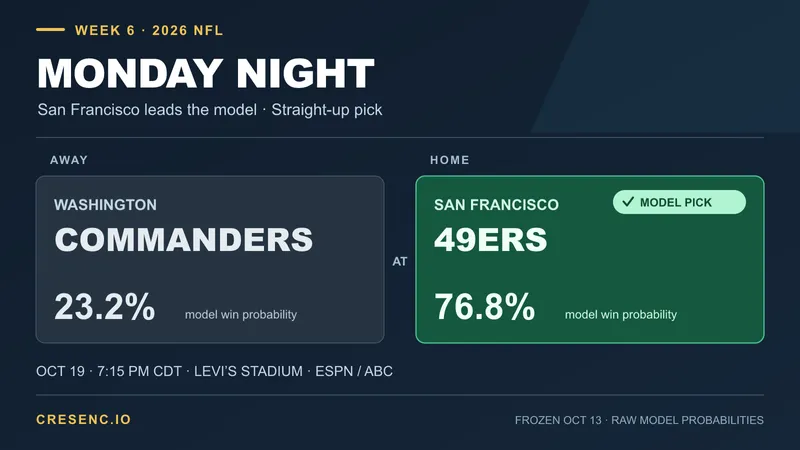
| Washington at San Francisco, October 19 | San Francisco 23–17 | San Francisco — correct | Washington +7.5 — correct | Over 50.5 — incorrect |
| New England at Chicago, October 22 | Chicago 30–24 | Chicago — correct | Chicago −3 — correct | Over 50.5 — correct |
These grades use the original probability-based picks at their original lines. They are separate from the point-score model and from any decision to recommend a bet.
Monday is the distinction. San Francisco won by six, so Washington covered +7.5, but the teams combined for only 40 points. The saved total forecast leaned Over 50.5 at 51.6%. Sunday’s and Thursday’s games were complete sweeps; Monday’s was not.
A correct spread pick means the correct side of the handicap, not an exact winning margin. Monday’s separate point forecast was roughly San Francisco 29.4–Washington 22.3, or 51.7 combined points; that also pointed Over 50.5. Thursday’s Chicago preview projected Bears 26.08–Patriots 23.75, a 2.33-point margin and 49.83 total. Chicago actually won by six with 54 combined points. Its winner, spread and total probabilities all selected the winning sides, while the point forecast implied New England +3 and Under 50.5. We keep those outputs separate when grading the model.
The season record, with consistent comparisons
Our audit covers 20 completed nationally televised games played in the US evening through October 22. It includes the Wednesday season opener and the Melbourne game that aired Thursday evening in the US. Daytime international games are excluded. Using only the official TNF, SNF and MNF labels would exclude Melbourne and reduce the sample to 19; the ensemble would then be 12–7 on winners rather than 12–8. The broader definition is used consistently below.
The winner table uses the original published forecasts. Random forest and XGBoost winner forecasts are unavailable for the first ten games in this sample, so their 8–2 and 6–4 records should be compared with the same ten games for the other models.
| Winner model | All available primetime picks | Same ten games, Weeks 4–7 |
|---|---|---|
| Ensemble | 12–8 (60%) | 6–4 |
| Bayesian | 13–7 (65%) | 7–3 |
| Logistic | 11–9 (55%) | 6–4 |
| Elo | 10–10 (50%) | 5–5 |
| Random forest | 8–2 (80%; ten available) | 8–2 |
| XGBoost | 6–4 (60%; ten available) | 6–4 |
Spread and total tracking began in Week 4. Across the ten primetime games with original published market forecasts, the ensemble is 7–3 against the spread and 7–3 on totals, with no pushes in either sample.
| Market model | Spread record | Total record |
|---|---|---|
| Ensemble | 7–3 | 7–3 |
| Logistic spread / Linear total | 5–5 | 6–4 |
| Random forest | 8–2 | 7–3 |
| XGBoost | 5–5 | 4–6 |
Week 4 has a separate, pregame alternate market forecast. The saved dashboard grading track uses that version; on that track, the ensemble’s ten-game totals record is 6–4, while its spread record remains 7–3. This article uses the original publication consistently and retains the alternate as a comparison. Earlier missing spread and total forecasts are not backfilled. Elo and Bayesian market proxies are not counted as additional trained market models; their neutral total outputs are abstentions.
These are small samples of forecast accuracy, not a betting profit record. The tracked picks were not necessarily qualifying recommendations or actual wagers. In particular, Thursday’s Chicago–New England game had no qualifying portfolio offer. Monitoring is currently GREEN, but that does not establish probability calibration, and settled-bet ROI remains unavailable. A short winning sequence cannot establish that a quoted 57% chance is accurate to the percentage point.
Sunday night: Kansas City at Seattle
Sunday, October 25, 7:20 p.m. CDT. The frozen Tuesday ensemble gives Kansas City a 56.9% win probability. Its separate point projection is approximately Kansas City 24.2–Seattle 21.7. Three of the five individual winner models pick Kansas City, while Elo and Bayesian pick Seattle; there is meaningful disagreement behind the average.
The sportsbook view goes the other way. At our Saturday 10:13 a.m. CDT capture, BetMGM had Seattle −3, total 42, with Seattle −150 and Kansas City +125 on the moneyline. Our first Tuesday observation was Seattle −2.5 with a 42.5 total. Seattle stayed −2.5 through Friday before moving to −3 Saturday; the total also fell half a point Saturday.
The saved market probabilities are Kansas City +2.5 at 55.5% and Over 42.5 at 52.8%. Those numbers belong to those exact lines. They are not probabilities for Kansas City +3 or Over 42. At the Saturday capture, LowVig still offered Kansas City +2.5 at +107, illustrating why a single book’s move does not describe every available price. The project’s current moneyline comparison also flags Kansas City, but its apparent edge depends on unvalidated probabilities.
The football questions start with Kansas City’s protection and receiving options. Jaylon Moore, Rashee Rice and Brashard Smith are ruled out; Cooper McDonald and L’Jarius Sneed are questionable. Patrick Mahomes and Travis Kelce carry no game-status designation. Watch whether Kansas City can sustain drives without forcing low-percentage throws when protection breaks down. Chiefs final injury report
Seattle is without Zach Charbonnet, Drake Thomas and Chazz Surratt. Nick Emmanwori, DeMarcus Lawrence and Uchenna Nwosu are among its questionable players. Those availability questions make early pass protection, pressure and the distribution of rushing work useful things to watch. They do not, by themselves, prove why the line moved. Seahawks final injury report
Monday night: Dallas at Philadelphia
Monday, October 26, 7:15 p.m. CDT. The frozen ensemble favors Dallas to win at 55.5%, with a separate point projection of approximately Dallas 22.7–Philadelphia 22.1. Four of five winner models favor Dallas, though Elo strongly favors Philadelphia.
BetMGM’s Saturday market is Dallas −4.5, total 44.5, with Dallas −220 and Philadelphia +180. Those headline spread and total numbers match our first Tuesday capture. Dallas briefly moved to −4 Thursday before returning to −4.5 Friday and staying there Saturday. An unchanged start-to-finish number can therefore hide movement during the week.
The saved Under 44.5 probability is a modest 52.5%. The Dallas −4.5 cover probability is 57.6%, but that exposes an existing model inconsistency: Dallas cannot have a higher probability of winning by at least five than of winning at all within one coherent probability distribution. Separately fitted outputs currently violate that relationship. The dashboard can consequently show both a Philadelphia moneyline candidate and a Dallas spread candidate. These should not be presented as a coherent combined betting position.
Injury update, checked Saturday, October 24, at 11:53 a.m. CDT: Philadelphia and Dallas had not yet posted final game designations on their official injury tables. Friday’s report listed Saquon Barkley (hamstring) as limited; Dallas Goedert (knee), DeVonta Smith (hamstring) and Dontayvion Wicks (ankle) did not practice. Dallas listed Cobie Durant and DeMarvion Overshown (hamstrings) and George Pickens (shoulder) as full participants. These are practice statuses, not final Monday availability. Eagles Friday report, Eagles injury table, Cowboys injury table.
The final designations and Monday’s inactive list remain worth checking before kickoff. Watch which receiving options are active, whether Philadelphia can sustain its run game, and how Dallas handles third downs. This availability update does not change the frozen Tuesday forecast.
Why lines move—and what could matter this weekend
A line can change because expectations for the game change, because betting activity changes a sportsbook’s exposure, or both. The useful question is what new information arrived between observations. Weather forecasts, confirmed absences and wagers can affect the spread, total and moneyline differently; they do not necessarily move together.
Weather changes the scoring environment
Stronger wind can make deep passing and long field goals harder, while heavy rain can affect grip and footing. If a worsening forecast leads bettors and sportsbooks to expect less scoring, the total can fall. The spread can also shift if those conditions appear to hurt one team’s offense more than the other’s. A rain icon alone is insufficient: timing, intensity and wind matter, and a forecast that improves can remove an earlier weather discount.
For Kansas City–Seattle, the nearby National Weather Service hourly forecast shows 54–55°F, north wind around 2 mph and a 37% precipitation chance at 5–6 p.m. PDT Sunday, around the 5:20 kickoff. That is rain to watch with light forecast wind; it does not support attributing the total’s move from 42.5 to 42 to strong wind. This forecast was issued at 11:26 p.m. PDT Friday. NWS Seattle hourly forecast.
For Dallas–Philadelphia, Saturday morning’s NWS forecast calls for a clear Monday night, with an overnight low around 50°F. That is an overnight low, not a kickoff temperature; the available night-period forecast does not specify wind. It supplies no heavy-rain explanation for a scoring adjustment. Both forecasts describe nearby grid points, not conditions measured inside the stadiums, and neither establishes what caused the saved line moves. NWS Philadelphia forecast.
Injury updates change which team is being priced
An unexpected quarterback absence can change an entire offensive outlook. Missing blockers or receivers can lower a team’s scoring expectation; missing pass rushers or defensive backs can raise the opponent’s. The replacement’s quality and the matchup matter, so counting injured players alone is not enough. The key is whether the update changes what the market already expected: an anticipated absence may be priced in before the final report, while an unexpected clearance can move the price back.
This week’s examples are concrete. Kansas City losing Jaylon Moore and Rashee Rice gives bettors reasons to reassess protection and receiving depth. Seattle’s questionable defenders could pull that assessment in the other direction if they cannot play. For Philadelphia, final decisions on Saquon Barkley, Dallas Goedert, DeVonta Smith and Dontayvion Wicks could alter expectations for sustaining drives and finishing possessions. Additional confirmed offensive absences could favor Dallas or lower Philadelphia’s expected scoring; clearances could ease those concerns. These are possible effects of the availability updates discussed above, not established explanations for the moves already recorded.
Betting activity and other books can move the price
Sportsbooks also react to wagers. Action from bettors they consider informative can change their assessment of a number; money concentrated on one side can change their potential payout exposure. A book may adjust the odds before changing the spread, and other books can follow a market leader’s move without receiving the same bets themselves. A move across several books therefore need not represent several independent pieces of team news. Research on sportsbook pricing and market adjustments.
Bet counts and dollars wagered are different measures, and neither identifies a bettor’s information by itself. Our saved captures contain prices, not the order flow needed to label a change “sharp money.” For example, Seattle’s moneyline becoming more expensive, from −140 Tuesday to −150 Saturday, documents a price change; it does not tell us whether news, betting demand or a book’s adjustment drove it. BetMGM’s explanation of public betting percentages.
Put the news beside the movement
| BetMGM market | First project capture, Tuesday | Friday | Saturday |
|---|---|---|---|
| Kansas City at Seattle | Seattle −2.5 / 42.5 | Seattle −2.5 / 42.5 | Seattle −3 / 42 |
| Dallas at Philadelphia | Dallas −4.5 / 44.5 | Dallas −4.5 / 44.5 | Dallas −4.5 / 44.5 |
| Cincinnati at Baltimore | Baltimore −3 / 51 | Baltimore −1 / 48.5 | Baltimore +1 / 48 |
Cincinnati–Baltimore has the largest move shown: four spread points toward Cincinnati and a three-point drop in the total. Dallas’s unchanged endpoints conceal its brief Thursday move to −4. Across the 13 remaining games, ten BetMGM spreads and eight totals differ from Tuesday; five spreads and six totals changed since Friday.
To attribute a move, we would need the timing of the relevant forecast or injury update alongside prices before and after it, plus evidence of what happened across books. Our daily snapshots cannot isolate that cause. These are comparisons with the first saved Tuesday observation, not verified openers, and Saturday is not the closing market.
The practical implication for our model is that a new price can reflect information that arrived after Tuesday’s frozen forecast. A larger gap between model and market may therefore reflect stale inputs as well as a possible pricing disagreement. We preserve the original picks for grading and assess new conditions separately; the saved Kansas City +2.5 and Over 42.5 probabilities still cannot be relabeled as probabilities for +3 and 42.
Records and market snapshots come from the reviewed Saturday research package, through the completed October 22 game. Prices were captured October 24 at 10:13 a.m. CDT; the injury refresh is timestamped above.
Written by cresencio
← Back to blog